
We Built Multiple AI Products in Six Months. Here's What Actually Made Businesses Use Them
Building AI was not the hardest part. Making it useful inside real workflows was. These are the lessons we learned while taking VyaptIX products from problem to production.
Ajeet Singh
Co-Founder & CEO, VyaptIX Technologies

Over the last six months, our team at VyaptIX has built some AI products for very different kinds of work: collecting customer reviews, managing WhatsApp conversations, organizing service operations, and supporting credit decisions.
When we started, I assumed the hardest questions would be technical. Which model should we use? How should we structure the data? How do we make the output more accurate?
Those questions matter, but they were not the questions that decided whether someone would actually use the product. The real questions were much more practical: Does this remove a frustrating step? Can someone understand it without a training session? Does it fit into the way the team already works? Can they see a useful result quickly?
The AI model is rarely the hardest part. The hardest part is building the bridge between the model and the daily workflow.
Different Products, Different Problems, One Pattern
The products look different on the surface, but each one began with the same observation: valuable work was being lost inside a small, repeated point of friction.
AI Review Generator
Happy customers were willing to leave reviews, but the process was awkward and easy to forget. We reduced it to a guided interaction that takes about 20 seconds.
Setu
Important customer conversations were happening on WhatsApp, but ownership, follow-up, and reporting were scattered. Setu turns those conversations into a managed workflow.
BankLens
Credit teams were spending hours manually reviewing bank statements. BankLens structures the analysis, surfaces risk signals, and supports a faster, auditable decision.
None of these products started with the sentence, "We should build something with AI." They started with a workflow that was costing somebody time, money, attention, or trust.
Lesson 1: Start With Work People Already Hate Doing
The easiest automation to adopt is usually not the most impressive one. It is the one that removes a task people already complain about every week.
A business owner does not wake up wanting an AI solution. They want customers to respond. They want reviews to appear. They want their team to follow up. They want a decision to stop waiting in a queue. AI becomes useful only when it makes one of those outcomes easier.
The Test We Use Before Building
If the workflow disappeared tomorrow, would the user immediately notice and ask for it back? If the answer is no, the problem is probably not painful enough.
Lesson 2: The Workflow Matters More Than the Model
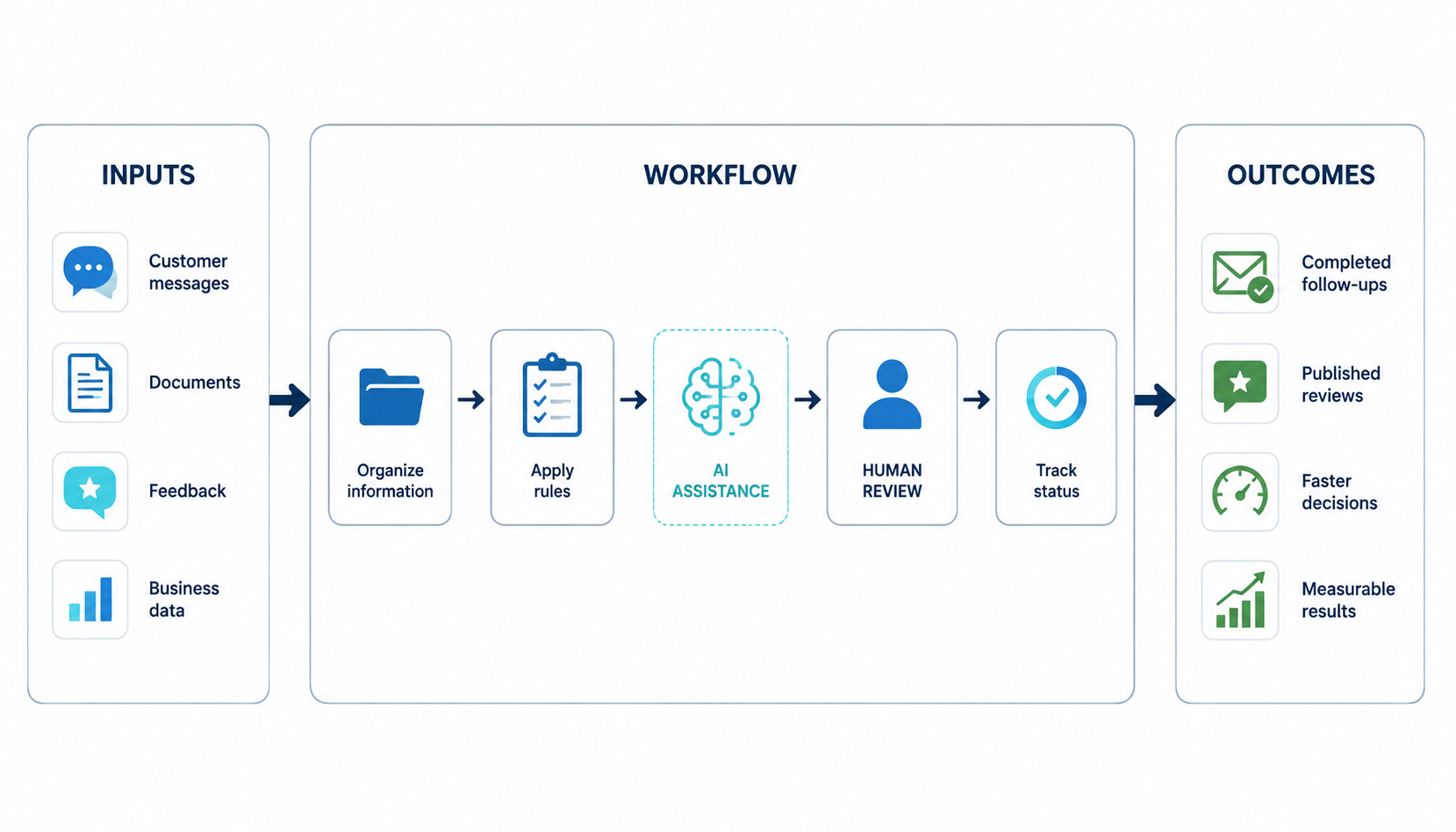
Model selection matters, but it is only one part of a working product. The surrounding workflow decides whether the output reaches the right person, at the right moment, with enough context to be useful.
| Question | Weak Starting Point | Useful Starting Point |
|---|---|---|
| What should we build? | An AI chatbot | A faster way to resolve a repeated customer request |
| What should we optimize? | Model output quality | The complete path from input to business result |
| How should success be measured? | Messages generated | Time saved, follow-ups completed, or decisions accelerated |
| When is it ready? | The demo looks impressive | A real user can complete the workflow without help |
This is also why we stay vendor-neutral. OpenAI, Claude, Gemini, and specialized models are tools. The correct choice depends on the workflow, risk, cost, speed, and accuracy requirements. The user should not have to care which model is underneath.
Lesson 3: Time to First Value Decides Whether a Product Gets Used
Every extra setup step asks the user to trust you before you have earned that trust. Long onboarding forms, complicated integrations, and weeks of configuration can kill adoption before the product has shown any value.
About 20 seconds
A customer can move from feedback to a ready-to-post review through the AI Review Generator.
First campaign in one session
Setu is designed to take a team from guided setup to its first WhatsApp campaign without requiring API expertise.
Analysis in minutes
BankLens turns a bank statement into structured signals and a decision-support report without hours of manual review.
Working automation in days
Our benchmark is a useful first workflow in 3-7 days where the problem and systems make that realistic.
Fast does not mean careless. It means reducing the distance between the user's problem and the first visible result. Once the value is visible, deeper adoption becomes a much easier conversation.
Lesson 4: Trust Is a Product Features
People do not adopt AI simply because it is capable. They adopt it when they understand what it is doing, when they can review important outputs, and when they know what happens if it is wrong.
- 1
Show the reasoning and result
Do not hide important decisions behind a black box. Give users enough context to understand and challenge the output.
- 2
Keep humans responsible for high-stakes decisions
AI can organize evidence and recommend an action. A qualified person should own the final decision where consequences are significant.
- 3
Build an audit trail
Teams need to know what happened, who approved it, and which information influenced the result.
- 4
Design the failure path
A product is not reliable because it never fails. It is reliable because failures are visible, contained, and recoverable.
The more important the workflow, the more important these trust mechanisms become. Speed earns attention. Trust earns continued use.
Lesson 5: Measure the Number That Matters
AI products make it easy to measure activity: prompts sent, messages generated, documents processed, or conversations handled. Activity is useful for debugging, but it is not the business outcome.
| Product | Useful Outcome to Measure | What Not to Confuse It With |
|---|---|---|
| AI Review Generator | Authentic reviews completed and rating growth | QR scans alone |
| Setu | Leads followed up, response time, and conversations converted | Messages sent alone |
| BankLens | Decision turnaround time, analyst hours, and review consistency | Statements processed alone |
If the business number is not moving, the automation is not finished.

What I Would Do Differently
Building several products quickly creates useful lessons, but it also exposes mistakes quickly. If I were starting again, I would be even stricter about four things.
Narrow the first user
A product becomes clearer when it solves one painful workflow for one recognizable user before expanding.
Watch real work earlier
What people say they do and what actually happens during a busy day are often different. The workflow must reflect reality.
Resist feature pressure
Every requested feature sounds reasonable in isolation. Too many features can hide the one result the product must deliver.
Document edge cases from day one
The happy path makes a demo. Handling unusual inputs, failures, and handoffs makes a product.
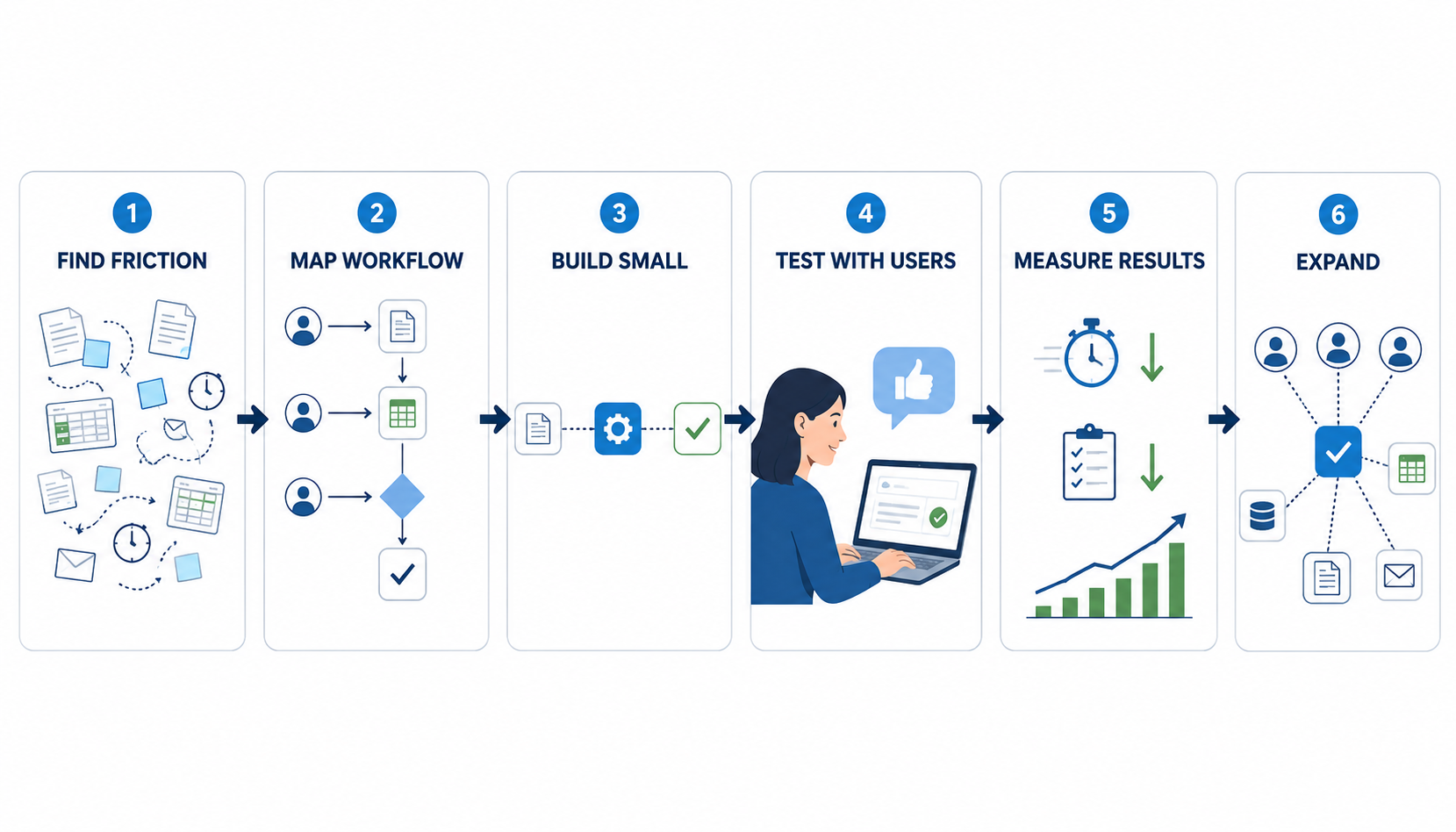
The Practical AI Product Playbook We Use Now
- 1
Find repeated friction
Look for work that is frequent, manual, slow, inconsistent, or easy to forget.
- 2
Map the current workflow
Understand the people, tools, inputs, decisions, and failure points before choosing technology.
- 3
Build the smallest complete loop
Solve the workflow from useful input to useful result. Do not stop at an impressive AI output.
- 4
Put it in front of a real user
Observe where they hesitate, what they ignore, and what they still do manually.
- 5
Measure one business outcome
Choose a result that the user already cares about and track whether it improves.
- 6
Expand only after the loop works
Add integrations, roles, reporting, and advanced features after the core workflow is useful.
What This Means for Businesses Exploring AI
Do not begin with a list of AI tools. Begin with a list of operational frustrations. Ask your team where work waits, where information gets lost, where customers repeat themselves, and where somebody has to remember to follow up.
Then choose one workflow that is painful enough to matter and contained enough to improve quickly. A small automation that becomes part of the working day is more valuable than a large AI strategy that remains in a presentation.
We Are Still Learning
Four products in six months does not mean we have solved every problem or found every answer. It means we have had the opportunity to see the same lesson from several different angles.
People do not want AI for the sake of AI. They want less friction, clearer decisions, faster responses, and work that does not fall through the gaps. Our job is to make the technology disappear into those outcomes.
Build for the workflow. Earn trust quickly. Measure the result.
If you are trying to identify the first useful AI workflow inside your business, tell us where the friction is. We will give you an honest view of what can be automated, what should stay human, and where to start: https://www.vyaptix.ai/contact